


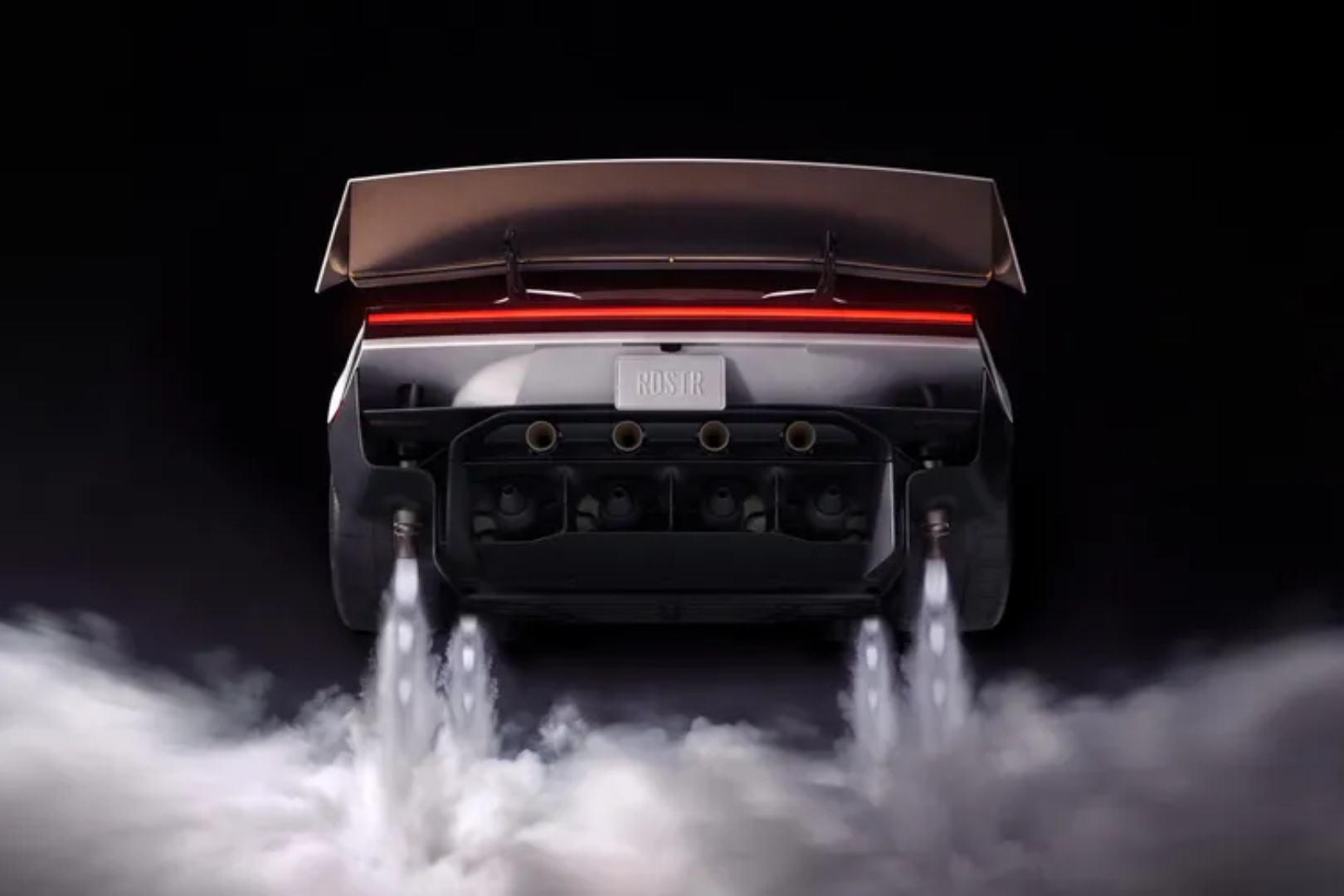
After years of anticipation, Elon Musk has presented the production version of the Tesla Roadster in a spectacular demonstration that goes far beyond a traditional electric car launch. Equipped with technology developed with expertise from SpaceX, the vehicle performed impressive aerial manoeuvres, including a jump above other cars and a controlled rotation in mid-air.
The demonstration has attracted attention across the automotive and technology industries. However, while the performance looks like something from science fiction, the vehicle’s flying capabilities come with important limitations.
A Tesla Roadster That Takes Performance to New Heights
The presentation took place at a site near Waco, Texas, normally associated with SpaceX rocket engine testing. During a live broadcast on X and YouTube, the Roadster demonstrated a series of unusual movements on a specially designed track.
In one sequence, the vehicle accelerated along a curved ramp before rising approximately 20 metres above the ground. It then performed an aerial manoeuvre that made it appear to hover briefly. In another demonstration, the car repeated the movement and passed above a line of Tesla vehicles.
These demonstrations introduced a very different vision of electric performance. Rather than relying exclusively on conventional acceleration and handling, the Roadster uses additional propulsion technology to achieve movements that ordinary production cars cannot perform.
Ten Cold-Gas Thrusters Inspired by SpaceX
One of the most unusual features of the vehicle is its propulsion system. The Rocket version is equipped with 10 cold-gas thrusters, developed using technology associated with SpaceX.
The system includes a larger composite pressure vessel positioned where the passenger seat would normally be. It supplies gas to several thrusters installed around the lower part of the vehicle.
By precisely controlling the pressure and direction of the gas released through these outlets, the system can influence the car’s movement in the air. Software and precision valves coordinate the thrust from different directions, allowing the vehicle to adjust its balance and perform controlled manoeuvres.
This configuration has similarities to the way a drone uses multiple propulsion units to maintain stability and change direction. However, the Roadster’s system is designed for a very different vehicle and demonstration environment.
Is It Really a Flying Car?
Despite the spectacular images, describing the Tesla Roadster as a conventional flying car would be misleading. Its aerial movements depend on a specialised propulsion system and are not comparable to the sustained flight of an aircraft.
The demonstrations show brief periods in the air rather than the ability to fly over long distances. The system also requires time to repressurise between performances, which limits how frequently these manoeuvres can be repeated.
Another important detail concerns the demonstration itself: no driver or passenger was visible inside the vehicle during the aerial sequences. The available information does not establish whether the car was operating autonomously or being controlled remotely.
The Rocket edition is also described as an invitation-only model rather than a vehicle openly available for purchase. It is not intended for public-road use and is presented as a track-only configuration.
Advanced Chassis Technology and Driving Performance
Beyond its unusual propulsion system, the Roadster also incorporates technologies designed to improve its behaviour on the track.
Among the announced features are steer-by-wire controls and an adjustable suspension system that lowers the vehicle in track mode. These technologies are intended to support handling and performance in demanding driving conditions.
Elon Musk has also highlighted the potential of the vehicle’s aerodynamic downforce and handling capabilities, suggesting that it could deliver extremely competitive track performance. However, such performance claims will ultimately need to be assessed through independent testing.
A Spectacular Concept with Practical Limitations
Tesla’s presentation raises an important distinction between technological demonstrations and everyday automotive use. The Roadster’s rocket-inspired system offers an unusual way to explore vehicle movement, but it does not automatically make the car suitable for normal road travel or practical flight.
Its specialised equipment, limited aerial operation and track-only status place it in a category of its own. The technology is impressive, but it should not be confused with a fully functional flying vehicle designed to transport passengers through the air.
What Does the Tesla Roadster Reveal About the Future of Cars?
The rocket-powered Roadster illustrates how automotive engineering can draw inspiration from aerospace technology. By combining electric propulsion, advanced vehicle controls and cold-gas thrusters, Tesla is exploring possibilities that go beyond conventional supercar design.
Whether these features eventually influence future production vehicles remains to be seen. For now, the Roadster stands out as an ambitious technological demonstration that challenges traditional ideas about automotive performance, while reminding us that spectacular aerial movements are not the same as practical flight.